From Sketch to Spec: How Process Discipline Builds Defense-Ready Precision
In defense manufacturing, precision is often associated with advanced equipment and tight tolerances. While both are critical, they are not where quality begins. Precision is established much earlier, through structured processes, disciplined planning, and collaborative problem-solving.
At its core, manufacturing reliability is not the result of a single step, but the outcome of a controlled and repeatable system.
Early-Stage Planning Sets the Foundation
Every component begins with a defined objective, whether that involves improving weld integrity, tightening tolerances, or refining an existing process. Before production begins, teams must first evaluate key variables such as material behavior, dimensional requirements, and process constraints.
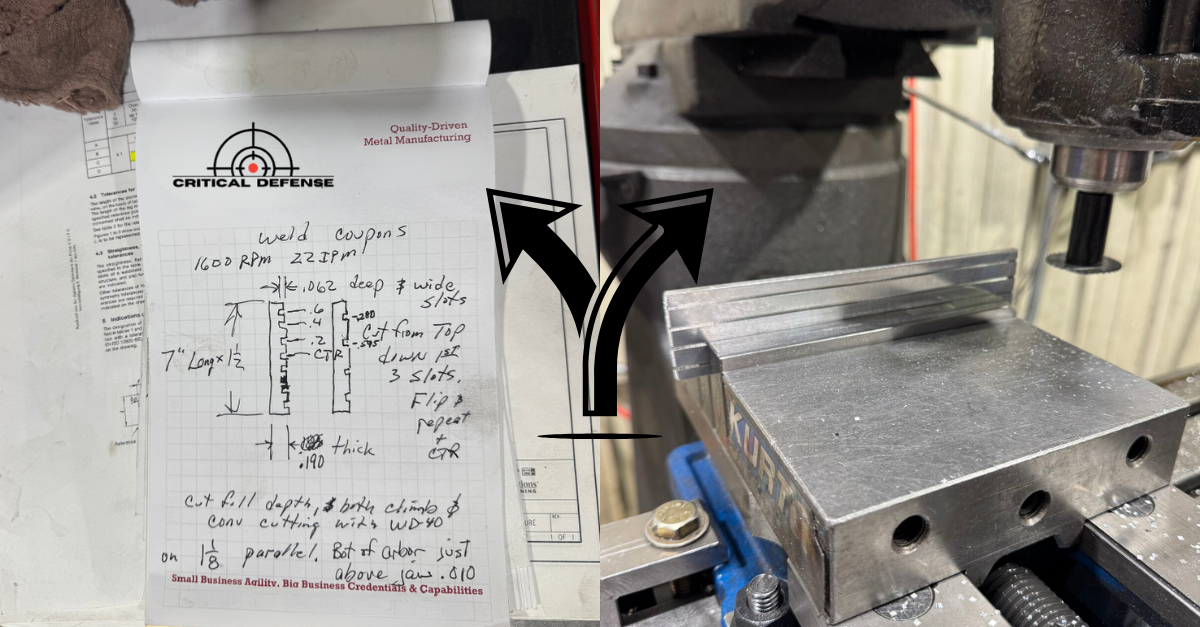
This stage often includes informal collaboration, notes, sketches, and team discussions, but it serves a critical purpose. It ensures that all contributing factors are considered before transitioning into formal design and production phases.
Establishing clarity early reduces variability later.
From Concept to Controlled Inputs
Once initial ideas are validated, they are translated into engineered drawings and process parameters. At this point, subjectivity is removed and replaced with measurable, repeatable inputs.
Specifications such as:
Speeds and feeds
Weld parameters
Tolerance ranges
Material conditions
are defined to ensure consistency across production.
This transition from concept to control is essential. Without clearly defined inputs, achieving repeatable outcomes becomes significantly more difficult.
Validation Through Testing
Before full-scale production, processes must be tested and verified. This is typically done through the use of sample components or weld coupons, which allow teams to evaluate performance under controlled conditions.
Testing serves several functions:
Identifying material responses to heat and stress
Verifying penetration and structural integrity
Refining machine settings and parameters
Reducing the risk of defects during production
Rather than being viewed as trial and error, this phase should be understood as structured validation. Each iteration provides data that improves the overall process.
Process Refinement and Repeatability
After initial validation, the focus shifts to refinement. Minor adjustments are made to improve consistency, reduce variation, and ensure that results can be replicated across multiple runs.
In processes such as laser welding, small changes in parameters can significantly impact final outcomes. As a result, refinement is not optional; it is necessary to ensure long-term reliability.
Repeatability is the benchmark of a stable process. Without it, quality cannot be sustained.
Why Process Discipline Matters
In high-performance industries such as defense manufacturing, the margin for error is minimal. Components must meet strict standards for performance, durability, and traceability.
While equipment plays an important role, it cannot compensate for weak or inconsistent processes. Quality is built through:
Defined procedures
Controlled variables
Documented standards
Continuous improvement
Organizations that prioritize process discipline are better positioned to deliver consistent, reliable results.
Precision in manufacturing is not achieved through a single action or piece of equipment. It is the result of a structured approach that begins long before production and continues through validation and refinement.
By focusing on process discipline, from initial planning to final execution, manufacturers can ensure that every component meets the standards required for demanding applications.
In environments where reliability is critical, strong processes are not just beneficial; they are essential.
